Surface protection films are essential for preventing scratches, contamination, and damage during manufacturing, transportation, and installation. However, choosing the right film depends on the adhesion technology and application requirements.
Two commonly used options are adhesive coated films and glueless co-extruded (co-ex) films. While both protect surfaces effectively, their structure, performance, and removal behavior differ significantly.
This guide explains the difference between adhesive coated films vs glueless co-ex films to help you make the right choice.
What Are Adhesive Coated Films?
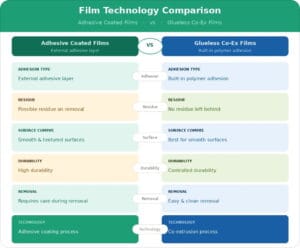
Adhesive coated films are traditional surface protection films that use a pressure-sensitive adhesive (PSA) layer to bond with the surface.
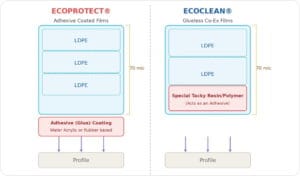
These films typically consist of:
- LDPE film layers
- A separate adhesive coating (water-based acrylic or rubber-based)
They are widely used across industries due to their strong adhesion and versatility.
Key Features
- Uses external adhesive coating
- Available in different adhesion strengths
- Suitable for smooth and textured surfaces
- Provides stable grip during processing
Advantages
- Strong and reliable adhesion
- Works well for long processing cycles
- Suitable for complex or rough surfaces
- Customizable adhesion levels
Limitations
- Risk of adhesive residue
- Requires careful selection based on surface
- Performance may vary with temperature
What Are Glueless Co-Ex Films?
Glueless co-extruded films are advanced protective films that do not use a separate adhesive layer. Instead, they rely on a tacky polymer integrated within the film structure.
Ecoplast’s ECOCLEAN® films are a great example of this technology, offering adhesive-free protection with clean removal.
How Co-Extrusion Works
In co-extruded films, multiple polymer layers are combined during manufacturing. The adhesion property is built into the film, eliminating the need for glue.
This results in:
- Uniform structure
- Controlled adhesion
- Residue-free removal
Key Features
- Adhesive-free design
- Uses tacky resin/polymer for bonding
- Multi-layer co-extruded structure
- Clean and easy removal
Advantages
- No adhesive residue
- Easy application and removal
- Consistent performance
- Ideal for sensitive and high-value surfaces
Limitations
- Limited adhesion range
- Not ideal for highly rough surfaces
- Requires precise formulation
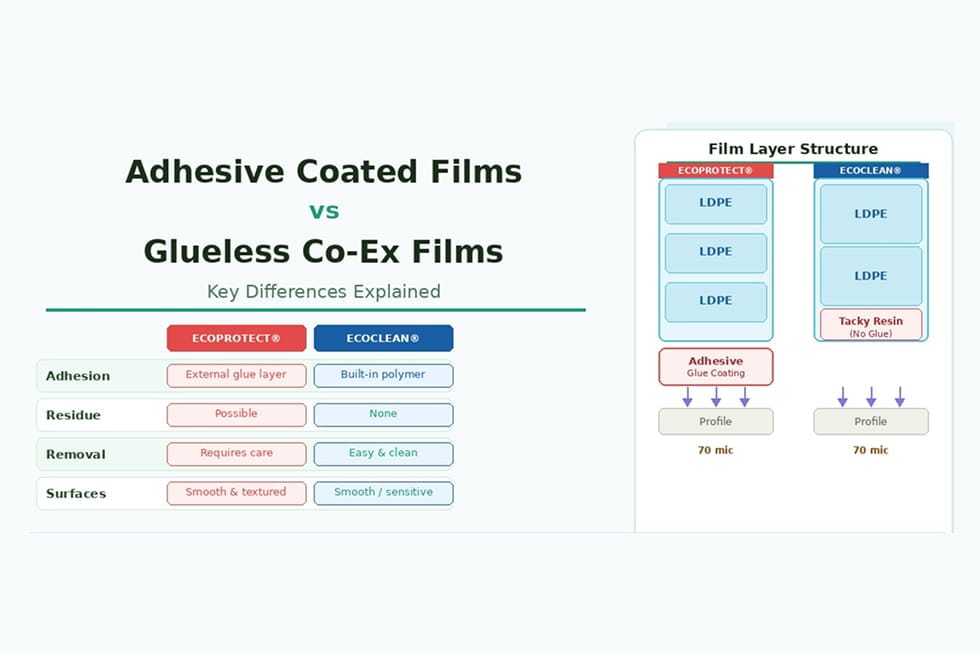
Structure Comparison: Adhesive vs Glueless Films
Structure of the Film
When to Choose Adhesive Coated Films
Choose these when:
- Strong adhesion is required
- Surface is rough or textured
- Long processing cycles are involved
- Heavy-duty applications
When to Choose Glueless Co-Ex Films
Choose these when:
- Residue-free removal is critical
- Surface is smooth or sensitive
- Easy handling is required
- Clean processes are important
Why Industries Are Moving Toward Glueless Films
Modern industries are increasingly adopting adhesive-free protective films due to:
- Cleaner operations
- Reduced surface damage risk
- Improved efficiency
- Better product finish
However, adhesive films still remain essential where high adhesion strength is required.
Frequently Asked Questions (FAQs)
1. What is the main difference between adhesive coated films and glueless co-ex films?
The key difference lies in the adhesion mechanism. Adhesive coated films use a separate glue layer, while glueless co-ex films use a built-in tacky polymer within the film structure, eliminating the need for external adhesive.
2. Do adhesive coated films leave residue on the surface?
Adhesive coated films may leave residue if the adhesive strength is not properly selected or if the film is exposed to extreme conditions. Proper grade selection helps minimize this risk.
3. Are glueless co-ex films completely adhesive-free?
Yes, glueless co-ex films are adhesive-free in terms of external coatings. They use a co-extruded polymer layer that provides adhesion without glue, ensuring clean and residue-free removal.
4. Which film is better for sensitive surfaces?
Glueless co-ex films are ideal for sensitive surfaces like polished metals, plastics, and laminates because they ensure no residue and safer removal.
Conclusion
Choosing between adhesive coated films and glueless co-ex films depends on your specific application, surface type, and performance requirements.
Adhesive coated films offer strong, customizable adhesion and are ideal for rough surfaces and demanding industrial processes. On the other hand, glueless co-ex films provide a cleaner, residue-free solution with easy removal, making them perfect for smooth and sensitive surfaces.
With advancements in film technology, manufacturers now have the flexibility to select the right solution that balances protection, efficiency, and surface quality. By understanding the differences, businesses can ensure optimal performance while maintaining the integrity of their products.
👉 Contact us today for a free consultation or custom quote!
📧 Email: [email protected]
🌐 Website: www.ecoplastindia.com