Pharmaceutical blister packaging has to do more than hold tablets or capsules. The packaging structure needs to protect the product, support efficient manufacturing, maintain dimensional stability during forming, and perform reliably through sealing, punching, storage, and distribution.
This makes material selection an important part of pharmaceutical packaging development. For manufacturers evaluating a PE Film Supplier for Pharmaceutical Blister Packaging, factors such as film quality, thickness, mechanical properties, thermoforming behaviour, sealing compatibility, and regulatory requirements all need to be considered.
The right supplier should not simply provide a film. It should offer a material solution that fits the blister structure, production equipment, pharmaceutical application, and required performance.
The Role of PE Film in Pharmaceutical Blister Packaging Performance
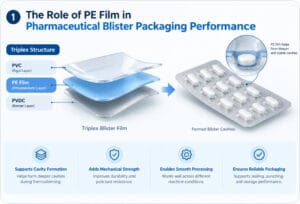
PE film can serve as an important functional layer within a pharmaceutical blister structure. In triplex blister packaging, for example, a PE film can act as an intermediate layer between rigid PVC and PVDC, helping the laminate form deeper cavities during thermoforming.
Ecoplast’s ECOPRIME® 113-A1 is specifically developed for Triplex Blister Packaging. The PE film is designed to support cavity formation, mechanical performance, puncture resistance, and processing across different machine conditions.
This highlights why selecting a pharmaceutical blister packaging film should be based on more than price or basic material specifications.
What Should You Look for in a PE Film Supplier?
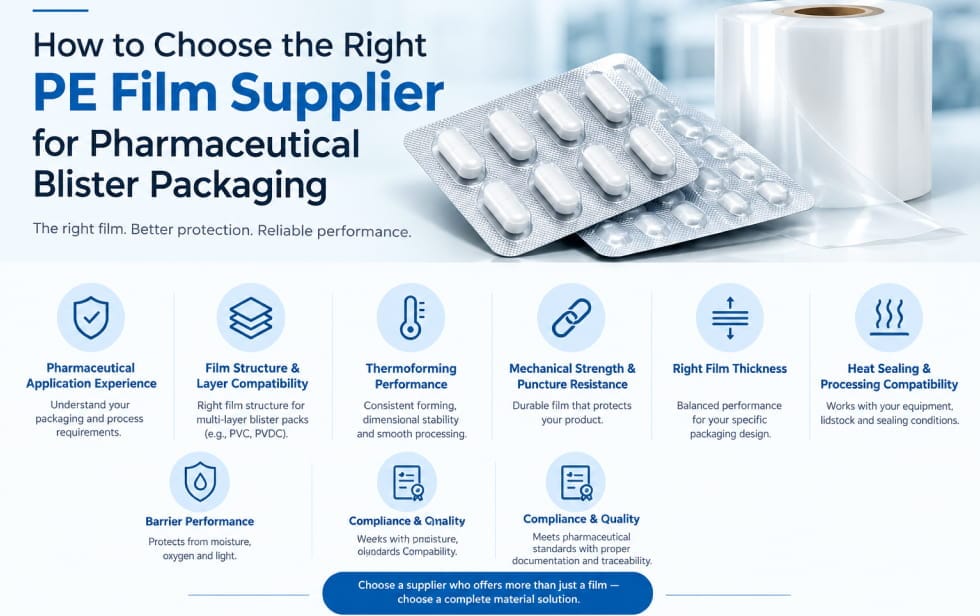
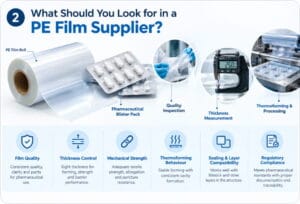
When evaluating a PE film supplier India, pharmaceutical manufacturers should consider several technical and operational factors.
1. Pharmaceutical Application Experience
Pharmaceutical packaging has different requirements from general-purpose packaging. The supplier should understand how the film interacts with the other layers of a blister structure and how it performs during thermoforming, sealing, perforation, and punching.
Experience with pharmaceutical applications can also make it easier to identify suitable film grades for different packaging requirements.
2. Film Structure and Layer Compatibility
A supplier should be able to provide the right film structure for the intended application.
A multilayer co-extruded film can combine different material characteristics within a single structure, allowing properties such as strength, flexibility, sealing, and barrier performance to be considered together.
For triplex blister applications, the PE layer needs to work effectively with materials such as PVC and PVDC while maintaining the required forming and mechanical properties.
3. Thermoforming Performance
Blister packaging involves forming cavities that hold individual pharmaceutical doses. The selected film therefore needs to perform consistently across the applicable forming temperature range.
Dimensional stability is particularly important because changes in the web during thermoforming can affect registration and the quality of the finished blister.
A suitable film should provide the required balance of elongation, tensile strength, puncture resistance, and forming behaviour.
4. Mechanical Strength and Puncture Resistance
The packaging needs to protect the pharmaceutical product during manufacturing, handling, and transportation.
A pharma grade PE film should therefore be evaluated for mechanical properties rather than appearance alone. Factors such as tensile strength, elongation, puncture resistance, and film uniformity can influence how reliably the finished packaging performs.
For triplex blister applications, Ecoplast states that its ECOPRIME® film provides puncture resistance, elongation, and tensile strength suitable for the application.
5. Appropriate Film Thickness
Choosing the correct film thickness for blister packs is another important consideration.
Thickness affects mechanical performance, forming behaviour, barrier performance, and the overall structure of the laminate. The ideal thickness depends on the packaging design and performance requirements rather than following a single universal specification.
Ecoplast’s ECOPRIME® 113-A1 is designed to provide high barrier performance at 25 to 30 micron thickness for high-barrier triplex blister packaging.
Heat Sealing and Processing Compatibility
A film may have excellent material properties but still create problems if it does not perform effectively with the packaging line.
A suitable heat seal film pharma solution needs to work with the selected lidstock, sealing conditions, machine speed, and package structure.
The sealing interface is particularly important because the film and lidstock need to form a reliable seal without compromising dimensional stability or the pharmaceutical product. Film selection should therefore consider the complete packaging system rather than the PE layer in isolation.
Machinability is equally important. Consistent unwinding, web handling, forming, sealing, perforation, and punching can help reduce production interruptions and maintain output quality.
Barrier Performance and Pharmaceutical Packaging Protection
Pharmaceutical products can be sensitive to environmental factors such as moisture, oxygen, and light. The packaging structure therefore needs to provide the level of protection required by the specific product.
A multilayer structure can be designed to provide different levels of barrier protection depending on the materials and layer arrangement. Moisture-sensitive products, for example, may require more advanced barrier structures.
This is why a supplier should be able to discuss barrier requirements as part of the complete blister structure rather than treating the PE film as an isolated component.
Compliance and Quality Considerations
Pharmaceutical packaging operates within a highly controlled environment. Material selection should therefore take pharmaceutical packaging compliance seriously.
A supplier should have clearly defined quality processes, traceability, appropriate documentation, and manufacturing controls relevant to the intended application.
Ecoplast states that its specialty pharmaceutical films are manufactured in ISO-certified cleanroom facilities and are designed for pharmaceutical applications requiring purity, performance, and compliance.
For pharmaceutical manufacturers, these capabilities can provide greater confidence when evaluating a long-term film supplier.
PVC Alternative Pharma Film: What Should You Consider?
The search for a PVC alternative pharma film is becoming part of broader conversations around material selection and packaging sustainability. However, replacing an established material is not simply a matter of choosing another polymer.
Any alternative needs to be evaluated against the complete packaging system, including thermoforming, sealing, barrier performance, mechanical properties, compatibility with existing equipment, and regulatory requirements.
The objective should be to select a structure that meets the pharmaceutical product’s protection requirements while remaining practical for the manufacturing process.
Why Supplier Capabilities Matter Beyond the Film
A reliable supplier should be able to support more than material delivery.
Technical support can become important when manufacturers need to evaluate:
- Film structure
- Thickness
- Thermoforming behaviour
- Lamination compatibility
- Mechanical properties
- Sealing performance
- Machine conditions
- Barrier requirements
- Quality documentation
This is particularly relevant for a flexible packaging film manufacturer serving pharmaceutical applications, where material performance and production consistency need to work together.
Ecoplast’s manufacturing capabilities include multilayer co-extruded polyethylene and co-polymer films, along with converting operations such as slitting, slicing, perforation, and rewinding.
Sustainable Considerations in Pharma Packaging
Sustainability is becoming another factor in packaging development. Manufacturers are increasingly evaluating material efficiency, recyclability, and overall packaging structures.
However, pharmaceutical packaging must balance sustainability goals with product protection, safety, compliance, and performance. A recyclable pharma packaging film should therefore be considered as part of the complete packaging system rather than as a standalone material choice.
The right approach depends on the pharmaceutical product, packaging format, applicable +regulations, and available recycling infrastructure.
Why Choose Ecoplast as Your PE Film Supplier?
Ecoplast Ltd. specialises in multilayer co-extruded PE and co-polymer films for packaging and specialty applications. Its ECOPRIME® range includes specialty films developed specifically for pharmaceutical applications, including Triplex Blister Packaging.
For manufacturers looking for a PE Film Supplier for Pharmaceutical Blister Packaging, the combination of application-specific film development, multilayer film expertise, manufacturing capabilities, and technical support can help simplify material selection.
The focus is not simply on supplying PE film, but on developing film solutions that align with the performance and processing requirements of the final pharmaceutical packaging structure.
FAQs
What should I look for in a PE film supplier for pharmaceutical blister packaging?
Look for pharmaceutical application experience, consistent film quality, suitable mechanical properties, thermoforming performance, thickness control, processing compatibility, quality documentation, and technical support.
Why is PE film used in triplex blister packaging?
PE can serve as a flexible intermediate layer between rigid PVC and PVDC. It can support deeper cavity formation during thermoforming while contributing to mechanical and processing performance.
What is the ideal film thickness for blister packs?
There is no single ideal thickness for every blister application. The appropriate thickness depends on the packaging structure, forming requirements, mechanical performance, barrier needs, and production process.
Can PE film replace PVC in pharmaceutical blister packaging?
A PE-based structure may be considered for specific applications, but material replacement needs to be evaluated against thermoforming, barrier, sealing, mechanical, equipment, and regulatory requirements.
Why is supplier experience important in pharmaceutical packaging?
Pharmaceutical packaging requires consistent material performance and controlled manufacturing. An experienced supplier can help manufacturers select suitable film structures and address processing and quality requirements.
Conclusion
Choosing the right PE Film Supplier for Pharmaceutical Blister Packaging requires looking beyond basic material specifications. Film structure, thickness, thermoforming performance, mechanical strength, sealing compatibility, barrier requirements, and pharmaceutical packaging compliance all contribute to the performance of the final package.
For pharmaceutical manufacturers, working with a supplier experienced in Multilayer Films, specialty PE films, and pharmaceutical applications can provide greater confidence in both material quality and production performance. Ecoplast’s ECOPRIME® range and expertise in multilayer co-extruded films position it to support demanding pharmaceutical packaging applications with application-focused film solutions.
Partner with Ecoplast for Pharma-Grade PE Films.
👉 Contact us today for a free consultation or custom quote!
📧 Email: [email protected]
🌐 Website: www.ecoplastindia.com