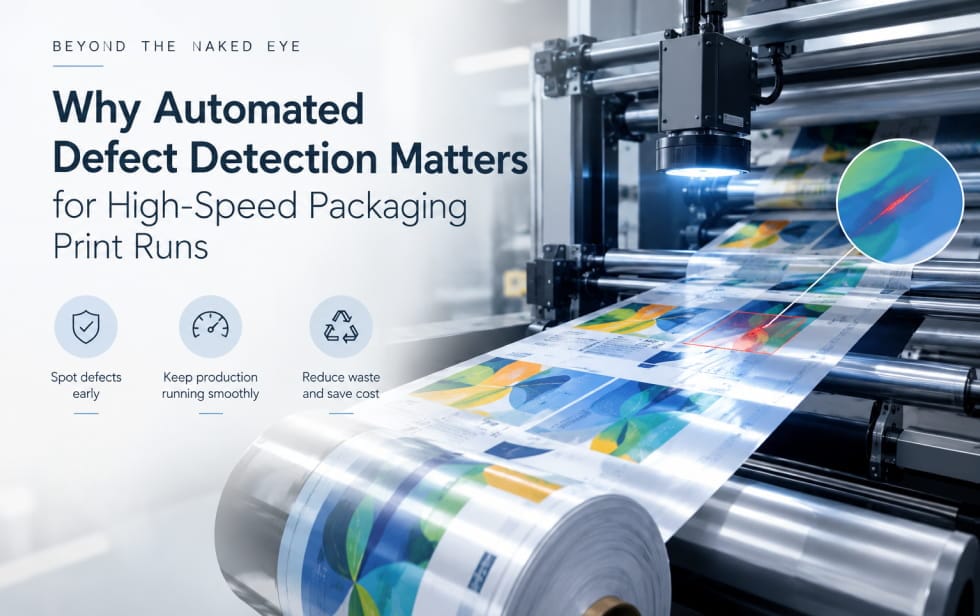
In flexible packaging, printing speed has become an important part of production efficiency. Modern presses can run at hundreds of metres per minute, allowing converters to produce large volumes in less time. But higher speed also creates a challenge: when something goes wrong, a significant amount of material can be affected before the problem is noticed.
A slight colour shift, registration movement, streak, or missing print may not be obvious when a production line is moving quickly. Manual inspection and periodic sampling still have a role, but they cannot provide continuous visibility across an entire print run.
This is where Alphaflex – Automated Defect Detection becomes an important area of discussion for modern packaging production. When high-speed flexographic printing is combined with automated inspection and real-time monitoring, manufacturers can identify quality issues earlier, reduce avoidable waste, and maintain greater consistency throughout a run.
What Happens Between Inspections on a High-Speed Print Run
Traditional quality checks often involve operators taking samples at intervals and comparing them against an approved reference. The approach works when production conditions remain stable, but a defect can develop between two inspection points.
On a high-speed press, even a short delay can mean metres of material have already been printed.
A small change in ink flow may affect colour. A movement in the web can influence registration. A damaged plate or contamination can create repeated marks across the print.
This is why automated inspection is becoming increasingly relevant. Instead of relying only on periodic checks, a vision-based system can continuously monitor the printed web and identify deviations while production is still underway.
What Is Automated Defect Detection in Packaging Printing?
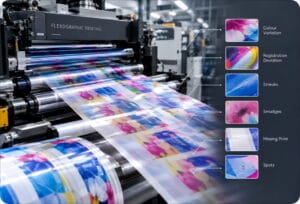
Automated defect detection uses cameras, sensors, image-processing software, and predefined quality parameters to inspect printed material as it moves through the production line.
An automated optical inspection (AOI) system can compare the live print against a reference and identify differences that may indicate a quality issue.
Depending on the system, this can include:
- Registration deviations
- Colour variation
- Missing print
- Streaks and smudges
- Spots and other surface marks
- Incorrect or incomplete graphics
- Repeated printing inconsistencies
The key advantage is continuity. Instead of checking only selected samples, the system can monitor the printed web throughout production. Modern inspection platforms are designed to operate at production speed and can record defect locations for later review or removal.
Why Print Defect Detection Matters at High Speed
The faster a press runs, the less practical it becomes to depend entirely on visual inspection.
A human operator may notice that something looks different, but identifying the exact point at which a defect started can be difficult. By the time it is detected, the issue may have affected a considerable length of material.
A continuous print defect detection system can help shift quality control from reaction to early identification.
1. Registration Error Detection
In multicolour printing, different elements need to remain accurately aligned. Even a small shift can affect text, graphics, barcodes, or colour boundaries.
Automated registration error detection can identify movement between print layers and alert operators before the issue develops into a larger production problem.
2. Color Consistency Control
Colour plays an important role in brand recognition. Small variations can become noticeable when packaging is produced across large volumes.
With color consistency control, inspection systems can monitor colour variation against defined references and help production teams respond to changes earlier.
3. Identification of Print Flaws
Common print flaws (streaks, smudges, missing print) can result from issues with ink, plates, substrate handling, or the printing process.
Vision-based systems can identify these irregularities while the web is moving, making it easier to locate and address the source.
4. Reduced Material Waste
Finding a problem earlier generally means less affected material needs to be discarded or reworked.
This supports reduced print wastage and can also reduce the time and resources spent investigating quality issues after production is complete. Automated inspection suppliers commonly position early detection as a way to reduce waste and improve production efficiency.
Machine Vision in Modern Packaging Production
The role of machine vision in packaging is expanding as printing lines become faster and more automated.
A machine-vision system can continuously capture images of the moving web and compare them against an approved reference. When a deviation crosses a defined threshold, the system can flag it for operator attention.
This approach provides more than a simple pass-or-fail result. Depending on the inspection setup, production teams can build a record of defects, their locations, and the conditions under which they occurred.
That information can help identify recurring problems and improve process control over time.

From Manual Checks to Real-Time Quality Control
Manual inspection is still useful, particularly during setup, sampling, and troubleshooting. The challenge is that people cannot continuously inspect every part of a fast-moving web with the same level of attention.
This is where real-time quality control printing line systems can complement operator expertise.
Instead of replacing the operator, automated inspection gives the production team another layer of visibility. It can highlight deviations while the job is running, allowing corrective action to happen closer to the point where the issue begins.
The result is a more informed production process, where quality decisions can be supported by continuous data rather than occasional observations.
Flexographic Printing and the Need for Consistent Inspection
The discussion around flexographic vs gravure defect rates is more complicated than simply comparing two printing methods. Defect occurrence depends on several variables, including press condition, substrate, inks, plates or cylinders, setup accuracy, operator expertise, and process control.
What remains consistent across high-volume printing is the need to identify defects quickly.
This is particularly relevant as modern flexographic presses become faster and more automated. W&H’s ALPHAFLEX, for example, is designed for flexographic printing at speeds of up to 500 m/min and includes automatic register and impression setting.
Ecoplast is among the companies in India that has adopted the ALPHAFLEX platform, reflecting the industry’s movement toward faster and more automation-supported flexible packaging production.
As production speeds increase, complementary quality-control technologies become increasingly valuable because the cost of discovering a defect late in the process can also increase.
Supporting Print Run Efficiency
The goal of automated inspection is not simply to find more defects. It is to help manufacturers produce consistently while using material, time, and machine capacity more effectively.
When defects are identified closer to their point of occurrence, teams can investigate the cause, make adjustments, and continue production with greater confidence.
This contributes to print run efficiency in several ways:
- Less material lost to extended defect runs
- Faster identification of recurring problems
- Better visibility into production quality
- More consistent output across long print runs
- Improved traceability of quality issues
- Less reliance on post-production inspection
The result is a production environment where quality control becomes part of the process rather than something performed mainly after it.
The Role of Ecoplast in High-Speed Flexible Packaging
Ecoplast Ltd. operates in the flexible packaging industry and manufactures multilayer co-extruded polyethylene and co-polymer films for flexible packaging and specialty applications. Its infrastructure includes high-speed converting equipment for slitting, slicing, perforation, and rewinding.
The company’s adoption of ALPHAFLEX also reflects its focus on strengthening printing capabilities as packaging requirements continue to evolve. W&H describes the press as a high-speed flexographic platform designed to combine production performance, stability, and ease of operation.
For a flexible packaging manufacturer, maintaining consistency across film production, printing, lamination, and converting is important. Automated inspection can form part of this broader quality approach by adding continuous visibility to the printed output.
Why Automated Defect Detection Is Becoming More Important
As packaging presses become faster, designs become more complex, and production volumes increase, quality control needs to keep pace.
A defect that once affected a relatively small quantity of material can quickly become a larger production issue when a press is running at high speed. Automated inspection helps address this gap by monitoring the web continuously and identifying issues that may otherwise be missed between manual checks.
The objective is not to eliminate human expertise. It is to give operators better information, earlier warnings, and greater control over the production process.
For manufacturers working toward zero-defect packaging manufacturing, this combination of automation, process knowledge, and continuous inspection can become an important part of modern quality management.
Why Choose Ecoplast?
With advanced film manufacturing capabilities, high-speed printing infrastructure, and modern converting facilities, Ecoplast combines technology and packaging expertise to deliver consistent, quality-focused solutions. Its adoption of the ALPHAFLEX platform further strengthens its high-speed flexographic printing capabilities, supporting efficient production, improved consistency, and reliable print quality.
With a focus on process efficiency and quality control, Ecoplast is equipped to meet the demands of high-volume flexible packaging applications. Its integrated capabilities help support dependable performance across printing and converting processes.
FAQs
What is automated defect detection in packaging printing?
It is a technology-based inspection process that uses cameras, image processing, and predefined quality parameters to identify defects in printed packaging during production.
What defects can automated inspection detect?
Depending on the system, it can identify registration errors, colour variations, missing print, streaks, smudges, spots, and other visual inconsistencies.
Can automated inspection reduce print waste?
Yes. By identifying defects earlier, manufacturers can address problems before they continue across a longer section of the print run. This can help reduce material waste and rework.
Does automated inspection replace manual quality checks?
Not necessarily. It is better viewed as an additional layer of quality control. Operators continue to make process decisions while automated systems provide continuous inspection and defect information.
Why is defect detection important on high-speed presses?
At higher speeds, more material can be produced before a problem is noticed through periodic inspection. Continuous monitoring helps shorten the time between defect occurrence and detection.
Conclusion
As Flexible Packaging production becomes faster and more automated, continuous quality monitoring is becoming increasingly important. Automated defect detection can help identify print issues earlier, reduce material loss, and support greater consistency across high-speed production runs.
For manufacturers working across Flexible Packaging, Multilayer Films, Lamination Films and Printing & Converting, combining advanced flexographic technology with automated inspection can create a more efficient and quality-focused production process. Ecoplast’s expertise across Industrial Applications and packaging film solutions reflects the industry’s broader move toward smarter and more reliable packaging production.
Contact Ecoplast Ltd for Flexible Packaging Solutions.
👉 Contact us today for a free consultation or custom quote!
📧 Email: [email protected]
🌐 Website: www.ecoplastindia.com