Surface protection films do more than prevent scratches during manufacturing, storage and transportation. When printed with the right information, they can also help workers identify the correct installation direction, handle the film properly and recognise the product or manufacturer.
For applications involving brushed stainless steel, aluminium profiles, pre-painted metal, ACP panels and uPVC profiles, even a small installation mistake can affect the final appearance. Grain direction may be reversed, the film may be applied incorrectly, or the protective layer may remain on the surface longer than recommended.
This is where printed surface protection film becomes useful. With clear directional markings, peel arrows, logos and batch codes, the film can combine surface protection with practical information for manufacturing and handling teams. The key is to make the printing functional, easy to read and suitable for the surface being protected.
What Is Printed Surface Protection Film, and What Should Be Printed on It?
A printed surface protection film is a temporary protective film that carries information or branding directly on its surface. Depending on the application, the print may include a company logo, product identification, installation instructions, removal guidance or directional markings.
Unlike a plain protective film, a printed version can communicate important information throughout production, storage and installation. This is particularly useful when multiple finishes, product sizes or material grades are handled on the same production line.
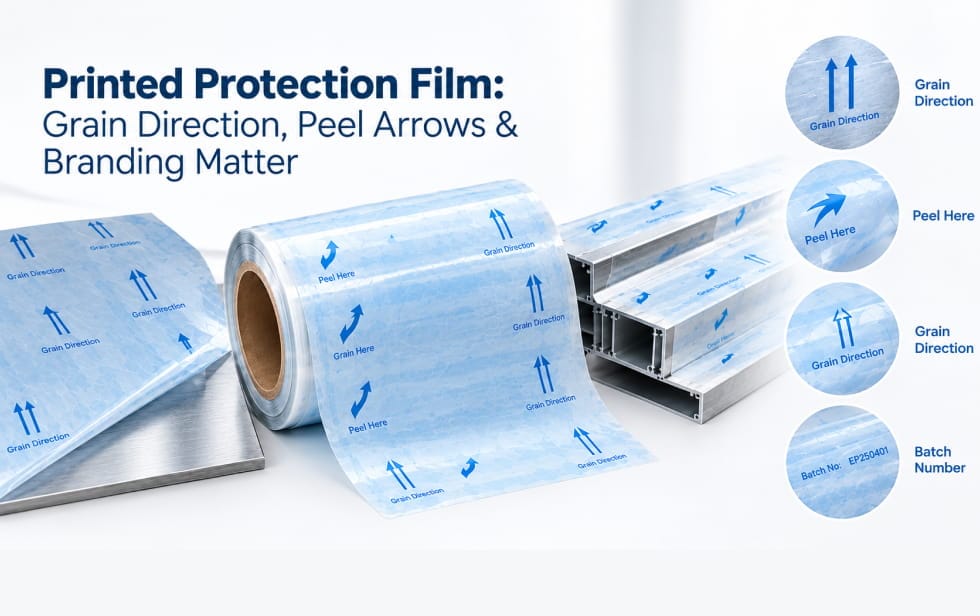
The type of printing depends on the application and the information that needs to be communicated. Logo printing and brand printing help identify the manufacturer, while grain direction arrows and peel arrows provide practical guidance to the person handling the material. A batch code can also help identify production batches when traceability is required.
However, printing should never interfere with the film’s primary purpose. Print adhesion, legibility, compatibility and clean removal all need to be considered when developing a custom protective film.
Why Grain Direction Arrows Matter on Protective Film
Many metal surfaces have a directional finish that needs to remain consistent across the finished product. This is especially important for brushed stainless steel, satin finish and hairline finish materials, where the visual effect depends on the direction of the surface texture.
If a panel is installed in the wrong orientation, the difference may become visible when adjacent sections are placed together. This grain mismatch can affect the overall appearance of lifts, architectural panels, appliances and decorative metalwork.
Printing grain direction arrows on the protective film gives workers a simple visual reference during cutting, fabrication and installation. It helps maintain consistency when several panels are processed or assembled separately.
This is particularly useful for aluminium profiles, pre-painted metal, ACP panels and appliance panels, where orientation and surface appearance matter. The markings should be clear, consistently positioned and easy to follow throughout the production process.
How Peel Arrows and Installation Instructions Help
Protective film needs to be removed at the appropriate stage, and clear markings can help workers identify where to begin. Printed peel arrows show the intended removal direction, making the process easier to follow during fabrication and installation.
These markings can be particularly useful when the film is applied to long profiles, large panels or products with multiple finished surfaces. They can also reduce confusion when different teams handle the same material at different stages.
Correct removal practices matter just as much as application. Leaving a protective film on for longer than its recommended period, especially under unsuitable environmental conditions, can increase the risk of difficult removal or adhesive residue. Residue from delayed removal may require additional cleaning and can affect production efficiency.
For operations involving laser cutting, bending and roll forming, the film must also be suitable for the intended process. Printed markings should remain legible where needed, while the protective film itself should be selected according to the surface, processing conditions and expected exposure time.
Logo Printing, Branding and Batch Identification
Printed protection film can also serve as a branding tool. A clearly placed logo identifies the manufacturer while the product moves through factories, warehouses, distributors and installation sites.
Logo printing and brand printing can help maintain brand visibility without requiring a separate label on every panel or profile. The printed film can carry the company name, product information or simple handling instructions while continuing to protect the surface underneath.
A batch code can provide an additional layer of identification. When products from different production batches need to be separated or traced, this information can help teams identify the relevant material more easily.
The design should remain practical. Text that is too small, repeated too densely or placed over an important viewing area may be difficult to read. The best approach is to keep essential information clear and avoid unnecessary printing.
Choosing the Right Printing Method and Film Type
The printing method should suit the film material, design requirements and production volume. Flexo printing is commonly used for flexible packaging and film applications because it can reproduce logos, text and directional symbols efficiently.
For a custom printed film, manufacturers should evaluate ink compatibility, clarity, durability and print adhesion. The ink needs to remain sufficiently stable during winding, storage, transport and application without interfering with the film’s protective function.
Film visibility also matters. A transparent film allows the underlying surface to remain visible, which is useful when workers need to inspect the finish during handling. An opaque film can provide a contrasting background for printed information and may be appropriate for applications with specific light-blocking or appearance requirements.
The choice depends on the substrate, adhesive system, processing conditions and intended duration of use. Testing the complete film-and-surface combination before full-scale production helps identify potential issues with adhesion, print transfer and removal.
Make Your Protection Film Work Harder with Ecoplast’s Custom Print
Ecoplast offers ECOPROTECT® surface protection films for applications including stainless steel, pre-coated metals, aluminium profiles, uPVC profiles, domestic appliances and metal composite panels. Its solutions are developed around the surface characteristics, processing requirements and protection needs of each application.
Ecoplast also provides printing options for surface protection films, allowing manufacturers to consider branding and product identification alongside surface protection. Its manufacturing capabilities include extrusion, printing, coating, lamination and converting, supporting the development of application-specific film solutions.
For businesses handling finished metal sheets, profiles and decorative panels, the right printed film can help communicate handling instructions, maintain brand visibility and support consistent installation practices. The film specification should account for the surface finish, print requirements, adhesion performance and removal conditions.
By considering these factors together, manufacturers can select a protective film that fits both the product and the production workflow.
Conclusion
Printed protection film can do more than prevent scratches. Grain direction arrows help maintain finish consistency, peel arrows guide removal, and branding or batch codes make identification easier throughout the supply chain.
The important part is getting the details right. Printing must remain clear, the film must adhere appropriately, and removal should not compromise the protected surface. With the right combination of film construction and printing, manufacturers can improve handling while preserving the appearance of the finished product.
Protect the surface. Guide the process. Keep your brand visible.
👉 Contact us today for a free consultation or custom quote!
📧 Email: [email protected]
🌐 Website: www.ecoplastindia.com