The quality of printed flexible packaging depends on more than the design itself. Printing technology, film stability, colour accuracy and production efficiency all play an important role in delivering consistent results. As packaging requirements evolve, manufacturers are increasingly investing in advanced printing systems that offer better control, precision and productivity.
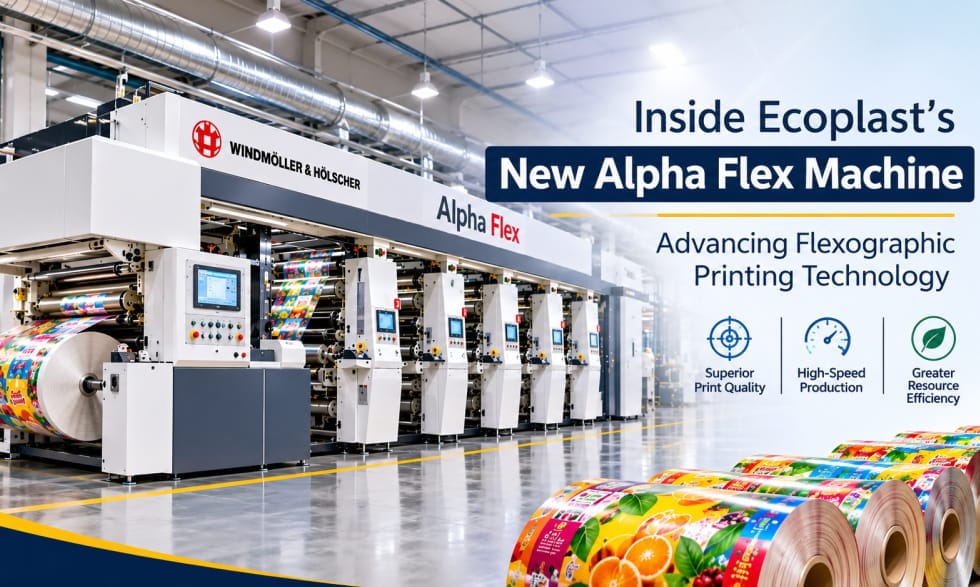
At Ecoplast, the addition of the W&H Alpha Flex machine from Windmöller & Hölscher (W&H) marks an important step in strengthening its in-house printing capabilities and advancing the quality of printed PE films.
What Is Flexographic Printing and Why It Matters for Film Packaging
Flexographic printing is a high-speed printing technique that uses flexible printing plates to transfer ink onto different substrates, including polyethylene (PE) films. It is widely used in flexible packaging printing because of its ability to produce consistent graphics, vibrant colours and detailed designs across production runs.
The flexographic printing process involves transferring ink from an ink system to a printing plate, which then applies the image onto the film surface. Its adaptability to flexible materials and suitability for continuous production make it an important technology for packaging applications.
For printed PE films, maintaining print registration, film stability and uniform ink transfer is essential. Modern flexographic printing machines are designed to address these requirements while supporting efficient production and consistent output.
Understanding CI Flexo vs. Conventional Flexographic Printing
A Central Impression (CI) flexographic press uses a large central drum around which the printing stations are arranged. The film remains supported against the central impression drum as it moves through multiple colour stations.
This configuration helps maintain film stability during printing, which is particularly important when working with flexible substrates. Stable film movement supports accurate colour-to-colour registration and helps minimise variations in the printed output.
A CI flexo printing press is particularly valuable for applications requiring multicolour printing, consistent graphics and dependable print quality across production runs.
Key Features of the Alpha Flex Machine
The W&H Alpha Flex is an advanced flexographic printing machine designed to deliver high-quality printing with efficient production performance. Its Central Impression (CI) configuration uses a central drum to support the film as it passes through multiple printing stations.
This central impression flexographic press design helps maintain film stability during printing, supporting accurate registration and consistency across colours.
Key capabilities of CI flexo printing technology include:
- Precise print registration across multiple colour stations
- Consistent film handling during the printing process
- High-speed printing capabilities
- Improved colour reproduction and graphic clarity
- Efficient processing of flexible film substrates
The combination of advanced engineering and controlled printing operations makes the W&H Alphaflex a valuable addition to modern flexible packaging manufacturing.
Expanding Custom Printed Film Capabilities
Printed films play an important role in packaging by combining product protection with branding and communication. From product identification to visual differentiation on retail shelves, printing helps packaging serve multiple purposes.
With advanced flexographic printing technology, manufacturers can support a range of custom printed films featuring brand colours, graphics, product information and packaging designs.
Improved printing capabilities also support the production of printed PE films for applications where quality, consistency and reliable performance are important.
As the flexible packaging industry continues to grow, advanced printing infrastructure helps manufacturers deliver more dependable custom film printing services and meet the changing needs of packaging businesses.
Why Ecoplast Invested in In-House Flexo Printing
Investing in an advanced CI flexo printing press strengthens Ecoplast’s ability to manage printing operations within its manufacturing ecosystem.
In-house printing provides greater control over production planning, print quality, process coordination and consistency. It also helps align printing requirements with film manufacturing, reducing dependency on external processes and supporting better coordination across production stages.
For customers requiring custom printed films, this capability enables improved control over specifications, print requirements and manufacturing timelines. It also strengthens Ecoplast’s ability to respond to varying requirements for printed PE films across packaging and industrial applications.
The investment reflects Ecoplast’s focus on building manufacturing capabilities supported by modern technology and process control.
How the Alpha Flex Improves Print Quality, Speed and Sustainability
Advanced printing technology can contribute to improvements across three important areas: print quality, production efficiency and resource utilisation.
Print Quality: The central impression drum supports film stability during printing, helping achieve consistent registration, sharper graphics and uniform colour application. This is particularly important for multi-colour designs and printed films where visual consistency matters.
Production Speed: Designed for high-speed flexographic printing, the Alpha Flex supports efficient printing operations and helps optimise production throughput. Improved process control and machine performance contribute to smoother production workflows.
Resource Efficiency: Better process control and efficient printing operations can help reduce avoidable print variations, setup-related material wastage and rework. These improvements can contribute to more efficient material utilisation during production.
While sustainability in packaging involves multiple factors, including material selection, product design and end-of-life considerations, improvements in manufacturing efficiency remain an important part of responsible production.
From PE Film to Finished Printed Film: The Printing Process
The production of printed PE films involves multiple stages that work together to achieve the required print quality.
The process begins with film selection and preparation, followed by artwork and printing plate setup. Inks are prepared according to the required colours and printing specifications. The film is then fed through the machine, passing through multiple printing stations where different colours are applied.
As the film moves through the printing units, controlled handling, registration and ink drying help achieve the desired print output. After printing, the film is inspected and rewound for further processing or delivery, depending on the application.
Each stage plays an important role in ensuring the quality and consistency of the finished printed film.
Advancing Flexible Packaging Printing at Ecoplast
The addition of the Windmöller & Hölscher flexo machine strengthens Ecoplast’s capabilities in flexible packaging printing and custom film printing services.
With advanced printing infrastructure, improved process control and a focus on consistent quality, Ecoplast continues to enhance its ability to deliver printed PE films for diverse packaging requirements.
The new Alpha Flex machine represents more than an equipment upgrade. It reflects Ecoplast’s continued investment in manufacturing technology, production capabilities and quality-focused processes as it moves forward in the evolving flexible packaging industry.
👉 Contact us today for a free consultation or custom quote!
📧 Email: [email protected]
🌐 Website: www.ecoplastindia.com